Is Your AI Vendor Training Your Competitor's Model?
Shared AI models learn from every distributor on the platform. Here is why that puts your edge at risk, and 8 data questions to ask any AI vendor.


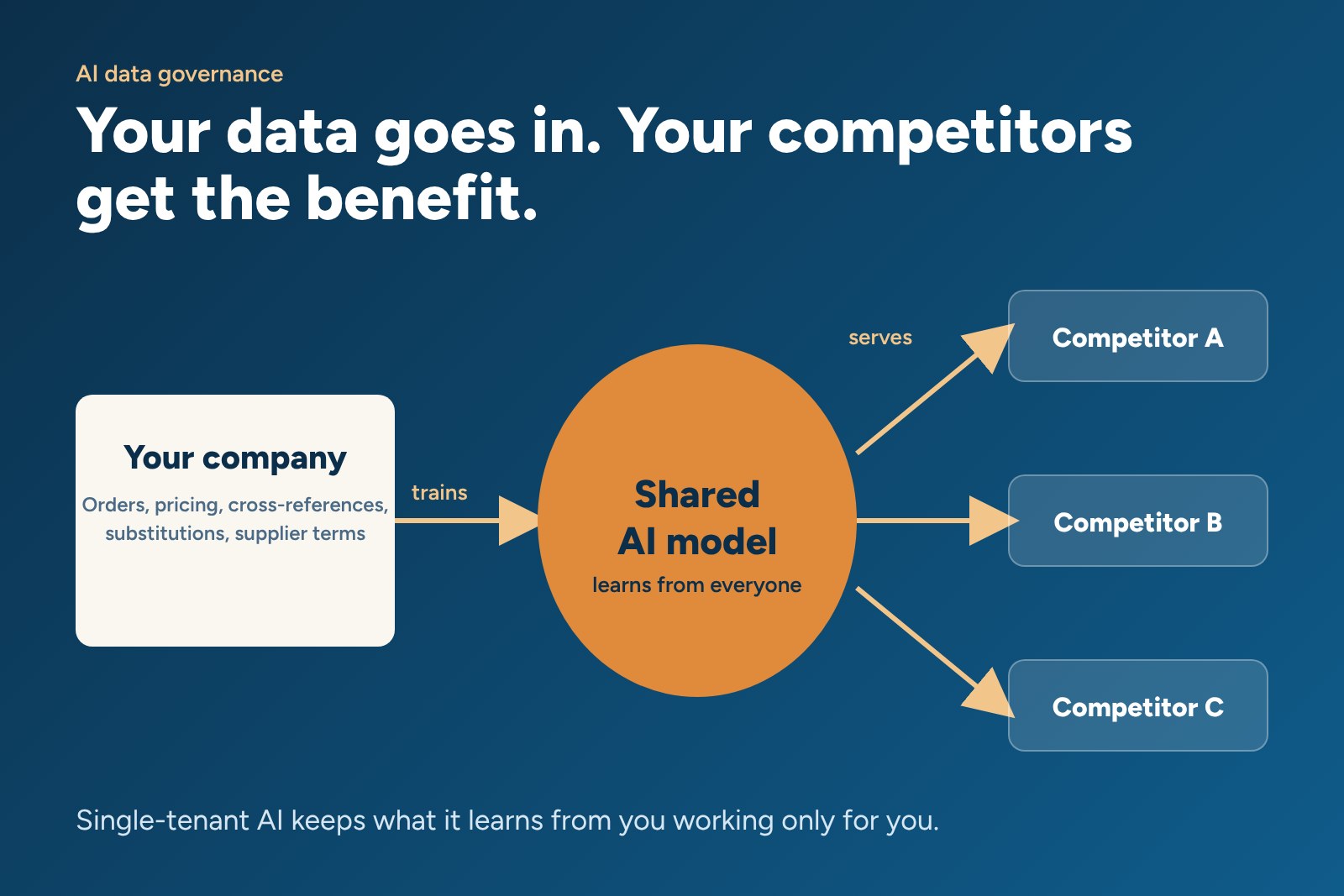
Table of contents
OptionShort answer: Many AI tools for distributors learn from every customer on the platform. If your orders, pricing and cross-references help train a shared model, part of your competitive edge becomes available to every other distributor using that tool, including your direct competitors. A single-tenant system keeps what it learns from you working only for you.
This is the question very few distributors ask when they buy AI, and the one I think matters most over the next five years.
How do shared AI models learn?
Most AI products get better with more data. That is the honest appeal of a shared model. A vendor can say the system has seen millions of orders across hundreds of distributors, so it gets smarter faster.
The catch is where that learning comes from. When your team corrects a product match, picks a substitute or reads a messy takeoff, that correction can become training data. In a shared model, the next customer benefits.
What is actually inside your order data?
It is worth listing, because it is more valuable than most people realize.
- Cross-references. Which customer part numbers, competitor numbers and descriptions map to which of your SKUs.
- Substitution logic. What your best reps offer when an item is out, and which customers accept which substitutes.
- Pricing behavior. Which customers get which prices, and how your team handles quotes.
- Customer patterns. Who orders what, when, in what quantities, from which branch.
- Supplier terms. What you pay, who confirms quickly and who changes prices.
- Tribal knowledge. How your veterans read the orders nobody else can.
Together, that's decades of judgment, and it's what separates you from the distributor across the street.
Why does this matter more in distribution than elsewhere?
Distribution is a relationship and knowledge business with thin margins. Two distributors often carry overlapping lines from the same manufacturers. What sets one apart is service, speed and knowing what the customer means. If an AI shared across your market learns those things from you, the gap between you and your competitors narrows.
What is the difference between shared, logically separated and single-tenant?
- Shared model: your data lives on shared infrastructure and helps every customer on the platform.
- Shared infrastructure, logically separated: shared systems with access controls. Who your data helps depends on the vendor's training policy.
- Single-tenant, dedicated model: your own instance, and your data helps only you.
Logical separation can be perfectly secure for storing data. The question is different. It is about what the model learns from and who benefits from that learning.
What 8 questions should you ask any AI vendor?
- Does my data train any model that another customer uses?
- Is my deployment single-tenant, or shared infrastructure with logical separation?
- Do corrections my team makes improve only my model, or everyone's?
- Which third-party AI providers process my data, and do they retain or train on it?
- What independent attestation do you hold, such as SOC 2 Type 2?
- Does my ERP stay the system of record?
- If I leave, what happens to my data and to what the model learned from it?
- Will you put the answers to questions 1 and 7 in the contract?
If the vendor answers question 1 with anything longer than one clear sentence, keep asking.
What should your IT and legal teams look for in the contract?
Ask for plain language on data ownership, training rights, retention, deletion at termination and subprocessors. "We may use aggregated or anonymized data to improve our services" is a common clause. Ask exactly what it covers and whether it includes training models other customers use.
How does Revalgo handle this?
Every Revalgo customer runs on a single-tenant deployment. Your orders, pricing, supplier terms and catalog train your instance only, never a shared model and never a competitor's. Revalgo maintains SOC 2 Type 2 attestation, and your ERP stays the system of record. We made that choice on purpose because we come from distribution and know what that data is worth.
Frequently asked questions
What does single-tenant mean in AI software?
It means your company runs on its own dedicated instance rather than sharing one with other customers. In Revalgo's case, your data trains your instance only.
Is a shared AI model less secure?
Not necessarily in terms of access. The bigger issue is learning. A shared model can carry patterns learned from your data into other customers' results.
Does anonymizing data solve the problem?
Not fully. Removing your company name doesn't remove the patterns, like substitution logic or cross-references, that make your data valuable.
What is SOC 2 Type 2?
It is an independent audit of a service provider's security, availability and confidentiality controls over a period of time, usually six to twelve months.
Should my ERP remain the system of record when using AI?
Yes. AI should read from and write to your ERP, not replace it as the source of truth for orders, pricing and inventory.
Who should be involved in evaluating AI data governance?
IT or security, legal, and the business owner of the process being automated. The business owner is the one who knows which data is a competitive edge.
Mike Mayer is CMO of Revalgo and has spent 23 years running digital and order-desk strategy for manufacturers and distributors.
Related reading: What Does a Non-Stock Order Really Cost a Distributor? and What Should AI Order Entry Actually Do for a Distributor?